Prop Speed: A Detailed Guide to a Modern Foul-Release Coating for Marine Propellers

Marine growth on propellers is one of those small problems that quietly causes big consequences—reduced speed, increased fuel burn, vibration, and drivetrain wear. Prop Speed is a widely used solution designed specifically to keep underwater metals—especially propellers—clean without relying on traditional antifouling paints.

What is Prop Speed?

Prop Speed is a two-part foul-release coating system developed for underwater running gear, such as:

  • Propellers (bronze, stainless steel, Nibral)
  • Shafts and struts
  • Trim tabs and rudders
  • Stern gear and saildrives

Unlike antifouling paints that kill marine organisms, Prop Speed works by creating a super-slick surface that prevents growth from adhering in the first place.
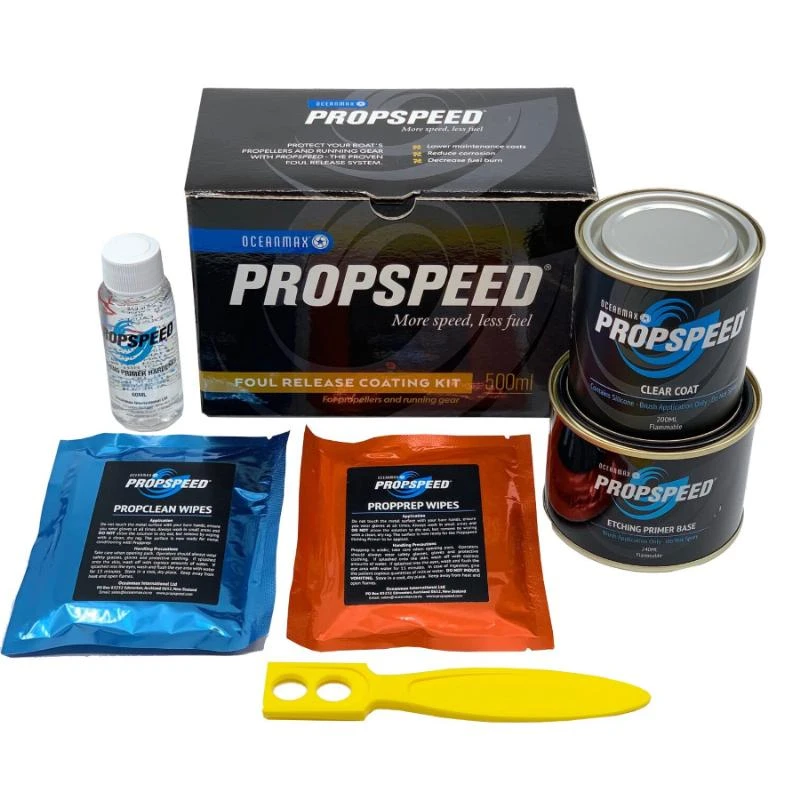
Prop Speed: A Detailed Guide to a Modern Foul-Release Coating

How It Works (Foul-Release, Not Biocidal)

Traditional antifouling coatings rely on biocides (such as copper) to deter growth. Prop Speed takes a different approach:

Key mechanism
  • Forms a low surface-energy coating
  • Marine organisms (barnacles, algae, slime) struggle to attach
  • Any growth that does settle is easily washed off by the water flow

This concept is similar to non-stick surfaces—adhesion is minimised rather than chemically prevented.

System Components

Prop Speed consists of two main layers:

1. Etching primer
  • Chemically bonds to the metal surface
  • Ensures strong adhesion of the topcoat
  • Critical for longevity
2. Silicone-based topcoat
  • Provides the slick, non-stick finish
  • Transparent or slightly amber
  • Extremely smooth to the touch

Why Propellers Need Specialised Coatings

Propellers operate in a uniquely harsh environment:

  • High rotational speed
  • Cavitation and turbulence
  • Constant immersion in oxygen-rich water

Standard hull antifouling paints:

  • Often fail quickly on propellers
  • Can flake off under rotation
  • Increase surface roughness → reduce efficiency

Prop Speed is engineered to:

  • Remain intact under rotation
  • Maintain a smooth hydrodynamic surface
  • Resists peeling and erosion better than conventional coatings

Works well on Fixed, Folding and Feathering Propellers (Screws).
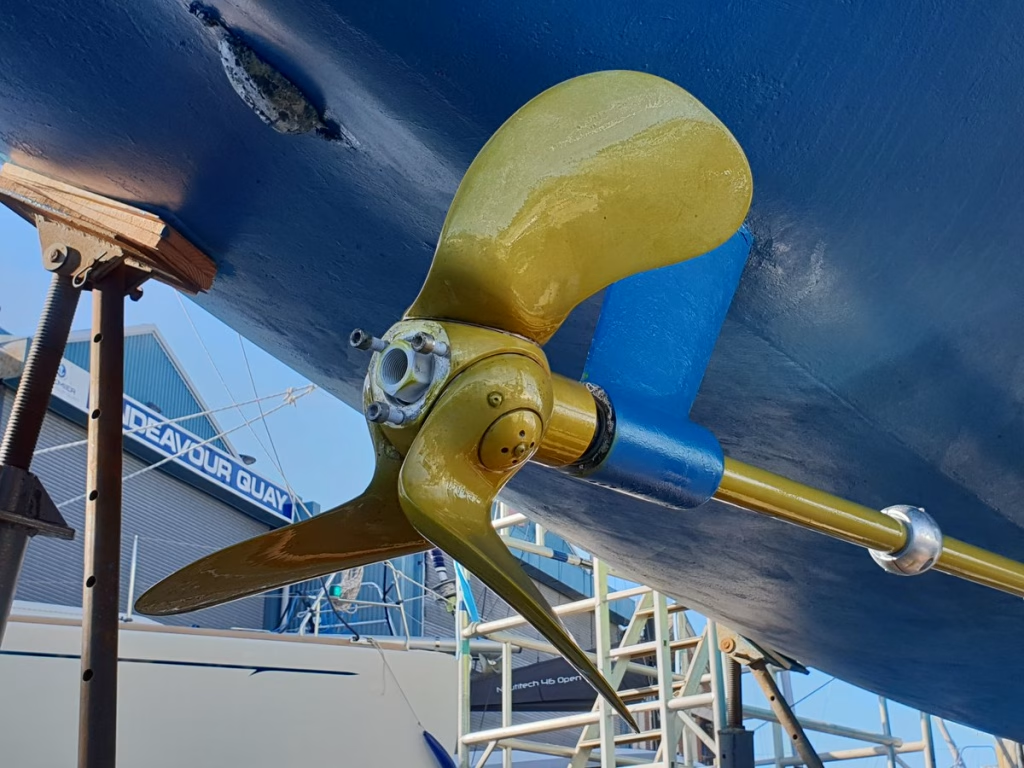
Prop Speed on sailing yachts

Performance Benefits

1. Improved fuel efficiency

A fouled propeller can reduce efficiency dramatically. A clean prop:

  • Maintains optimal blade shape
  • Reduces drag
  • Improves thrust

Fuel savings of 5–15% are often reported, depending on conditions.

2. Better speed and performance
  • Higher achievable top speed
  • Improved acceleration
  • More predictable engine load
3. Reduced vibration

Marine growth causes:

  • Imbalance in the rotating mass
  • Cavitation irregularities

A clean propeller runs more smoothly and quietly.

4. Lower maintenance
  • Less need for underwater cleaning
  • Reduced haul-out frequency
  • Easier wipe-down if fouling begins

Application Process (Critical to Success)

Prop Speed’s performance depends heavily on proper application.

Typical steps:
  1. Surface preparation
    • Remove all old coatings
    • Abrasive sanding or grit blasting
    • Degreasing (very important)
  2. Immediate priming
    • Apply etching primer within a strict time window
    • Prevent oxidation of bare metal
  3. Topcoat application
    • Applied shortly after primer
    • Requires precise timing and conditions
  4. Curing
    • Must cure before immersion
    • Launch timing is critical
Key point:

Application is time-sensitive and technique-dependent, which is why many owners rely on trained applicators.

Limitations and Considerations

1. Cost
  • More expensive than standard antifouling
  • Professional application adds to cost
2. Durability
  • Typically lasts 1–2 seasons
  • Performance depends on:
    • Water temperature
    • Fouling intensity
    • Vessel usage
3. Sensitivity to damage
  • Scratches or impacts can compromise the coating
  • Care is needed during haul-outs and maintenance

Comparison with Alternatives

Traditional antifouling paint

Pros:

  • Cheaper
  • Easier DIY application

Cons:

  • Poor adhesion to metals
  • Short lifespan of propellers
  • Increased drag

Bare polished propeller

Pros:

  • No coating cost
  • Maximum smoothness initially

Cons:

  • Fouls quickly (sometimes within days)
  • Requires frequent cleaning

Other foul-release coatings

Prop Speed is often compared to:

  • Velox systems
  • Propshield coatings

Its advantage lies in:

  • Proven track record
  • Widely adopted by commercial and cruising fleets

Suitability for Different Boats

Ideal for:
  • Bluewater cruising yachts
  • Performance sailboats
  • Motor yachts
  • Commercial vessels
Especially valuable when:
  • Long periods between haul-outs
  • Warm, high-fouling waters
  • Fuel efficiency is a priority

Environmental Perspective

Because it is non-toxic, Prop Speed:

  • Does not leach harmful chemicals
  • Is considered more environmentally friendly than copper-based paints

However:

  • Surface prep and solvents still require responsible handling

Practical Insight for Offshore Sailors

For offshore and passagemaking vessels:

  • A fouled prop can compromise engine reliability in critical moments
  • Prop Speed helps ensure:
    • Reliable motoring in calms
    • Efficient battery charging (via engine alternator)
    • Better maneuverability in tight situations

Many long-distance sailors consider it a high-value upgrade, especially before major passages.

Final Thoughts

Prop Speed represents a shift from chemical antifouling to physical foul-release technology. While it comes at a higher upfront cost and demands careful application, the payoff is:

  • Cleaner propellers
  • Better performance
  • Reduced long-term maintenance

For sailors and operators who depend on consistent propulsion performance, it’s less of a luxury and more of a strategic investment in reliability and efficiency.

On sailing vessels, the effectiveness of Prop Speed can vary because the propeller (“screw”) is used less frequently; with reduced rotation and water flow, the self-cleaning effect can be somewhat diminished, allowing light fouling to establish more easily than on regularly used motor-driven props.

This article is independent and not affiliated with or endorsed by Prop Speed, and no payment or compensation has been received for its content.

Author

Renaming your boat
The perfect gift

So, you bought a boat. It is beautiful, gracious, and even elegant. Unfortunately, its name suggests otherwise.

Boaty McBoatface wasn’t precisely what you were looking for in a boat name. Neither was the name “Master Baiter” or “Filthy Oar”. And “Bikini Inspector” and “Wasted Seaman” were also not quite to your taste.

You need to change the name of your boat. But before you do, ensure you read this book, for failure to adhere to the name-changing ceremony could lead to the sinking of your boat…

The Book of Maritime Idioms

Many old sailing, maritime, and nautical terms have found new meanings in modern English. From feeling blue to showing your true colours, from pipe down to eating a square meal per day, all these modern expressions find their origin in the maritime industry.

The comprehensive list of 200+ idioms will surprise you. Beautifully illustrated, this book covers the idiom’s etymology, current meaning, and an example of how we use it in modern-day speech.

Leave a Comment

Your email address will not be published. Required fields are marked *