In sailing, the point of sail describes the angle between a boat’s course and the direction of the true wind. It is a fundamental concept because a sailboat cannot travel directly into the wind; instead, it operates within a range of angles relative to it.
The main points of sail are typically grouped into five categories: in irons (head to wind), close-hauled, beam reach, broad reach, and running. Each point of sail represents a different balance between aerodynamic lift from the sails and hydrodynamic resistance from the hull and keel, which directly affects boat speed and handling.
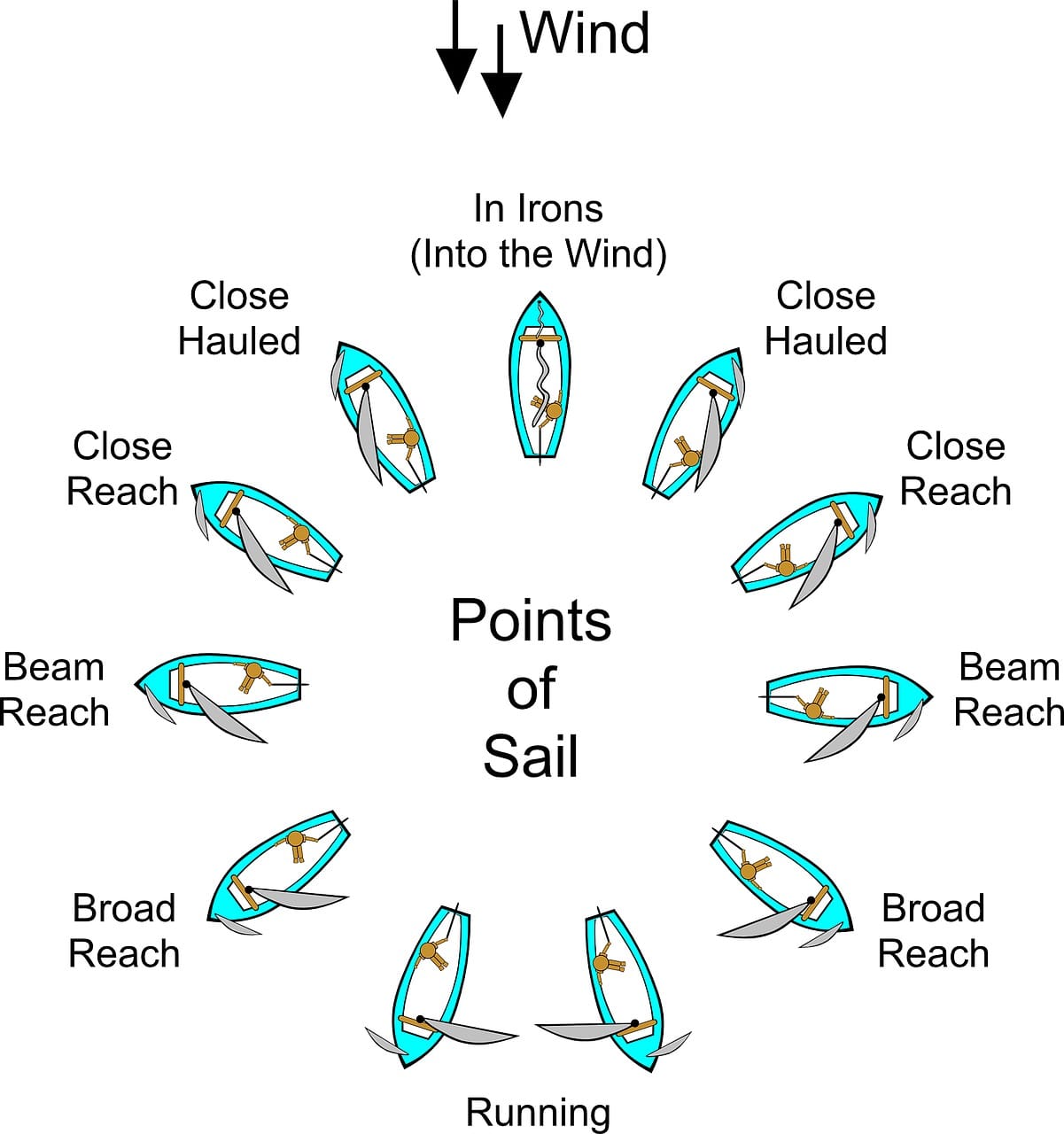
1. Into the Wind (No-Sail Zone or “In Irons“)
- Angle: 0° to 30° from the wind
- Description: A sailboat cannot sail directly into the wind. This area is referred to as the “no-sail zone.” The sails will luff (flap) if you try to sail in this direction, and the boat will lose speed and eventually stall or even drift backwards.
- Note: Also referred to as the “NO GO ZONE (NGZ)”.
2. Close-Hauled (Beating)
- Angle: 30° to 45° from the wind
- Description: This is the point of sail closest to the wind. The sails are pulled in tight (trimmed in), and the boat sails at a sharp angle to the wind. Sailing close-hauled is efficient, but the boat must tack (zigzag) to make headway upwind.
- Speed: Fast but demanding on sail trim and balance.
- Note: Sheets are all in, and the helmsman steers the boat using the tell-tales.
3. Close Reach
- Angle: 45° to 60° from the wind
- Description: The boat is angled a little further off the wind than close-hauled, with sails still relatively tight. It’s a fast and powerful point of sail, often used for covering distances efficiently.
- Note: The sheets are not all the way. The helmsman steers a specific course while the trimmers set the sails using the tell-tales.
4. Beam Reach
- Angle: 90° (wind coming from directly across the side, or “beam”)
- Description: The boat sails with the wind coming directly from the side. This is typically one of the fastest and easiest points of sail because the sails are neither too tight nor too loose.
- Speed: Typically the fastest point of sail.
5. Broad Reach
- Angle: 120° to 160° from the wind
- Description: The boat is angled with the wind behind the beam, and the sails are let out. This is a stable point of sail often used for long downwind journeys, though it can create significant heeling (tilt).
- Speed: Fast but can be challenging in stronger winds.
6. Running (Downwind)
- Angle: 160° to 170° from the wind
- Description: The wind is directly behind the boat, and the sails are fully released. Sailing downwind is slower than a beam or broad reach because the wind doesn’t generate as much lift on the sails—it’s mostly pushing the boat forward.
- Speed: Stable but slower than other points due to less lift.
- Note:
- 170° to 180° (directly downwind), also known as the “DANGER ZONE (DZ)”, is usually avoided due to the risk of an accidental gybe. A preventer can be used to mitigate accidental gybes. This can be achieved by running a line from the end of the boom forward and back into the cockpit to prevent the boom from moving.
Summary of Points of Sail:
- No-Sail Zone: Directly into the wind (0° to 30°) – Boat cannot sail.
- Close-Hauled: 30° to 45° – Sailing as close to the wind as possible.
- Close Reach: 45° to 60° – Slightly off the wind, fast and efficient.
- Beam Reach: 90° – Wind directly from the side, typically the fastest.
- Broad Reach: 120° to 160° – Wind behind the beam, good for downwind travel.
- Running: 160° to 180° – Directly downwind, sails fully out.
Knowing the points of sail allows you to adjust sail trim and course, ensuring they can navigate efficiently based on wind direction.
Sail trim refers to how the sails are adjusted—using sheets, halyards, travellers, and other controls—to achieve the most efficient shape and angle for a given point of sail. Because the wind interacts with the sails differently at different angles, the optimal trim changes continuously as the boat alters course.
For example, when sailing close-hauled, sails are trimmed in tightly to create a smooth airfoil shape that generates lift, allowing the boat to point as high into the wind as possible. On a beam reach, the sails are eased out to capture more wind directly, while still maintaining efficient airflow across their surfaces.
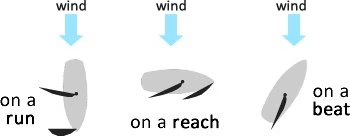
The relationship between point of sail and sail trim is essentially a dialogue between direction and shape. As the point of sail changes, sailors must adjust trim to maintain proper sail shape, minimise drag, and maximise forward drive.
Good trim is visible in telltales streaming evenly, a balanced helm, and steady boat speed. In this way, understanding point of sail is not just theoretical knowledge—it is the practical foundation for effective sail trim and efficient, controlled sailing.